
Q: Why does my child have a recurring fever of 38-39°C for three days with no other symptoms except a lip blister?

Updated: Sep 7
Medically reviewed by Sang Hyun Ahn, MD
Content edited by Myeongchan Kim, MD
This post is a dramatization of a question and answer session experienced by our actual medical reviewers. Please note that this content is for informational purposes only and does not constitute medical advice. Always consult with a qualified healthcare professional for any health concerns or before making any decisions related to your health or treatment.
Question:
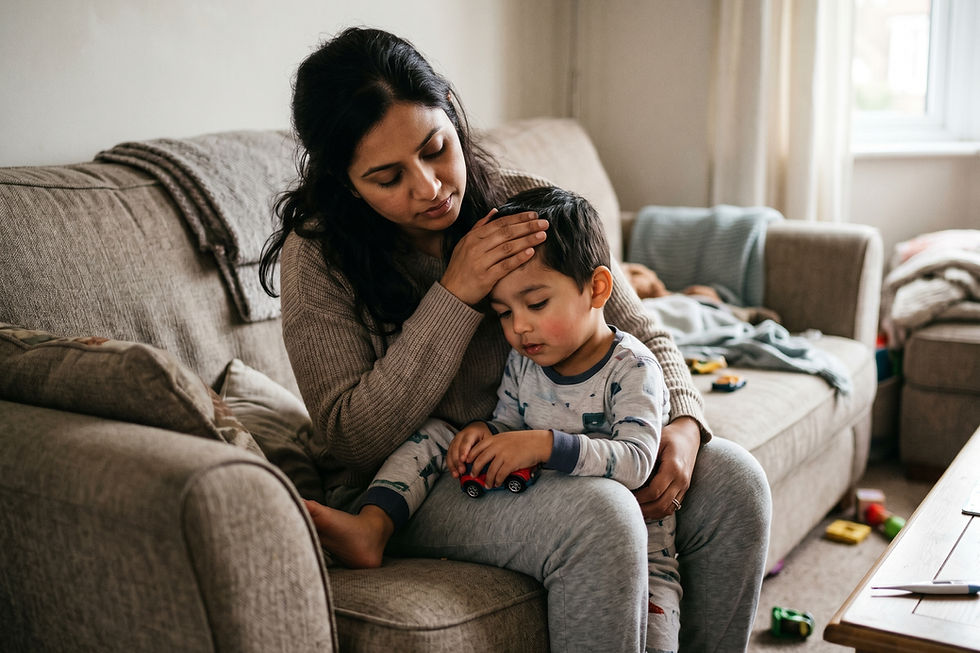
My child has a fever but no other symptoms. I got a call from daycare on Friday afternoon saying my child had a fever of 38.4°C. I picked them up immediately and visited the pediatrician. A flu test came back negative. My child received IV fluids with a fever-reducing injection and was prescribed antibiotics and acetaminophen powder to take twice a day (morning and lunch).
Since then, the fever has been fluctuating between 38°C and 39°C every 5 to 6 hours. The temperature drops nicely after taking the fever reducer, but then it spikes again. Despite the fever, my child's overall condition is good, and they are playing well. On Sunday morning, I noticed a single blister on their lip, but there are no blisters on the hands, feet, or inside the mouth.
We visited the pediatrician again on Monday morning for a second flu test, which was also negative. We were given the same prescription. The cycle continues—a fever of 38°C with no other symptoms, which drops with medication and then returns. Why is this happening?
Answer:
It is completely understandable that you are worried about a fever pattern repeating for three days, especially when there are no other prominent symptoms.
Based on your description, here is an analysis of the current situation:
• A recurring fever of 38-39°C for three days since Friday.
• Good response to fever reducers (the temperature drops effectively).
• Good general condition; the child is active and playing well.
• Two negative flu tests.
• One blister on the lip (with none on the hands, feet, or inside the mouth).
Possible Causes:
Early Stage of a Viral Infection: Often, a fever is the very first sign, and other specific respiratory or gastrointestinal symptoms may develop later.
Early Stage of Hand, Foot, and Mouth Disease (HFMD): The single lip blister might be the starting point. Blisters could potentially appear on the hands and feet within the next 2-3 days.
Roseola Infantum: This is a common childhood viral illness characterized by 3 to 5 days of high fever, followed by a distinct rash that appears just as the fever breaks.
Other unspecified viral infections.
What You Can Do Now:
• Hydration: Ensure your child drinks plenty of fluids (water or electrolyte drinks) frequently to prevent dehydration.
• Medication: Continue to use the prescribed fever reducers, but focus on giving them when the child is visibly uncomfortable rather than just chasing a number on the thermometer.
• Daily Checks: Inspect your child's mouth, hands, and feet daily for any new blisters or rashes.
• Log Symptoms: Keep a record of the fever pattern, noting exactly when the temperature spikes and when medication is given.
⚠️ When to Revisit the Doctor Immediately:
• The high fever persists for more than 4 days.
• The child becomes suddenly lethargic or completely refuses to eat or drink.
• You notice any signs of breathing difficulty or severe dehydration (e.g., no tears when crying, fewer wet diapers).
• A rash spreads rapidly all over the body.
Most childhood viral infections improve within 3 to 5 days. The fact that your child is playing well and maintaining a good general condition is a very positive sign. Please continue to observe them closely at home. If the fever persists past tomorrow or if any new symptoms develop, please visit your pediatrician for a follow-up evaluation.

For extra peace of mind and clear guidance when tracking your child's symptoms, the FeverCoach app is always there to help.