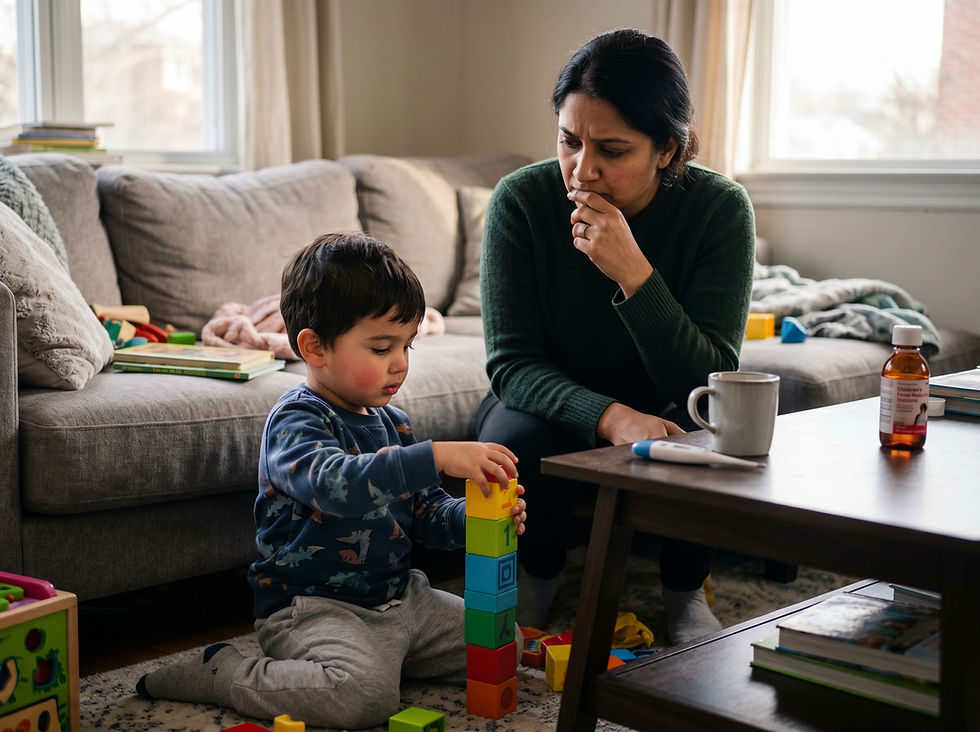
Q: My child was taking antibiotics for a cold, caught the flu, and got new antibiotics from a different clinic. Should I switch to the new ones?

Updated: Sep 7
Medically reviewed by Sang Hyun Ahn, MD
Content edited by Myeongchan Kim, MD
This post is a dramatization of a question and answer session experienced by our actual medical reviewers. Please note that this content is for informational purposes only and does not constitute medical advice. Always consult with a qualified healthcare professional for any health concerns or before making any decisions related to your health or treatment.

Question:
My child was taking antibiotics for a cold but suddenly developed a high fever again. We went to a different clinic, where they did a flu test. It showed a very faint positive line, so my child received an IV treatment. Because it was a different clinic, they also prescribed a new set of antibiotics. Since the original cold hasn't completely cleared up and now my child also has the flu, should we stop the old antibiotics and only take the new ones?
Answer:
It must be very worrisome to navigate the flu while your child is already trying to recover from a cold.
Current Situation Summary:
First Clinic: Treated for a cold and prescribed antibiotics.
Second Clinic: Tested positive for the flu, received an IV treatment (likely an antiviral medication), and was prescribed new antibiotics.
Key Medical Points:
The flu is a viral infection: Antibiotics do not treat viruses. If the IV fluid administered was an antiviral medication (such as Peramivir), the flu itself is already being treated.
Antibiotics target bacterial infections: Both clinics likely prescribed antibiotics out of concern for secondary bacterial complications, such as a middle ear infection (otitis media), sinusitis, or pneumonia.
What You Should Do Now:
Contact the second clinic or pharmacy: Call them and explain, "My child is currently taking [Name of the first antibiotic]. Should we switch entirely to the new prescription, or was the new medication prescribed to be taken differently?" Usually, doctors will recommend replacing the old medication with the new one, but this must be confirmed by the prescribing professional.
Do not mix medications arbitrarily: Never give your child both antibiotics at the same time without explicit medical direction, as this increases the risk of adverse drug interactions and antibiotic resistance.
Watch for warning signs: Even after receiving flu IV treatment, monitor your child closely. Seek immediate emergency medical attention if you notice any of the following:
The fever continues or worsens 48 hours after the IV treatment.
Breathing difficulties (e.g., rapid breathing, chest retractions where the skin pulls in around the ribs).
No urination for more than 8 hours.
Severe lethargy or difficulty waking up.
Antibiotic Safety Checklist:
Identify the exact name and dosage of the first antibiotic.
Reflect on whether you explicitly informed the second clinic that your child was already on an antibiotic.
Check the new prescription bag for specific instructions like "stop previous medication" or "take together."
Please call the pharmacist or doctor at the second clinic today to clarify the medication instructions before administering the next dose. If your child's fever does not subside after 48 hours, or if you are ever uncertain about their condition, please visit your pediatrician for an in-person evaluation.

For extra peace of mind and clear guidance when tracking your child's symptoms, the FeverCoach app is always there to help.