Q: My 14-month-old has only 2 teeth, still eats baby food, and had a febrile seizure. Should I be worried?
- Myeongchan Kim, MD

- Feb 28
- 2 min read
Updated: Jul 8
Medically reviewed by Sang Hyun Ahn, MD
This post is a dramatization of a question and answer session experienced by our actual medical reviewers. Please note that this content is for informational purposes only and does not constitute medical advice. Always consult with a qualified healthcare professional for any health concerns or before making any decisions related to your health or treatment.
Question:
My 14-month-old son has me worried about a few things. First, he only has two bottom teeth. Is this a developmental delay? Second, since he's over a year old but has so few teeth, he is still eating baby food. Is it okay to continue? Lastly, he had a febrile seizure at 38.6°C during a recent cold, where he shivered and his face and palms turned bluish. Should we see a specialist for an EEG or other tests?
Answer:
It sounds like you're dealing with several common concerns about your 14-month-old at once. Let's address them one by one.
Dental Development
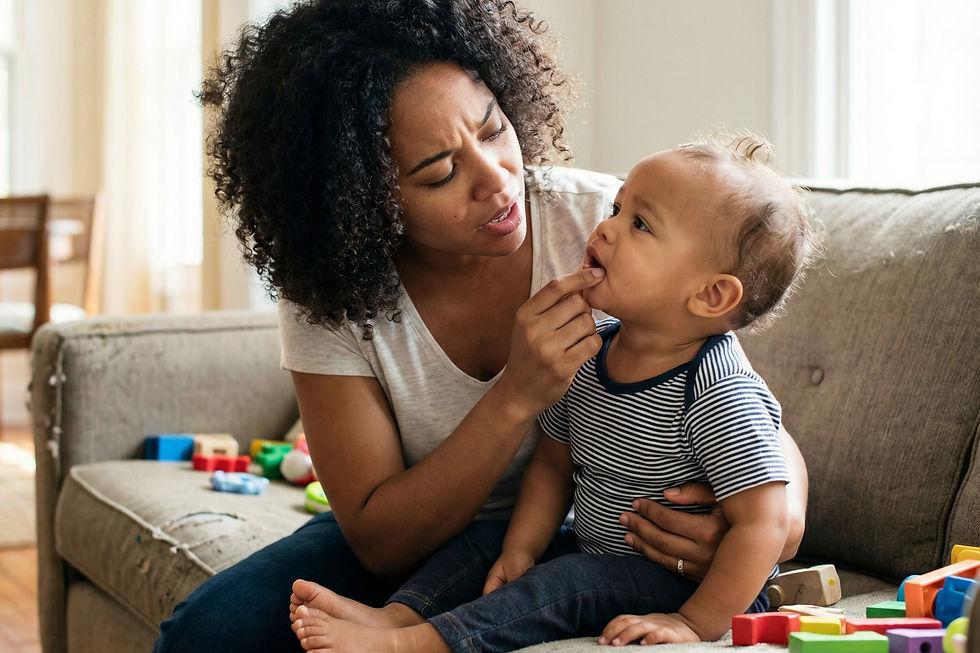
Having only two bottom teeth at 14 months is on the later side, but it is still within the normal range.
• The first tooth typically erupts between 6-12 months, but it's considered normal for it to appear anytime up to 18 months.
• Overall development is more important than the specific order or timing of teething.
→ My recommendation is to wait until your baby is 18 months old. If no new teeth have appeared by then, it would be a good time to consult a pediatric dentist.
Continuing Baby Food
It's perfectly fine for a baby over one year old to still be eating baby food!
• Even with few teeth, babies can effectively mash food with their gums.
• You can slowly start introducing soft solid foods.
• Practice with finger foods like pieces of banana or steamed sweet potato.
→ The most important thing is to go at your baby's own pace.
History of a Febrile Seizure ⚠️
A seizure at 38.6°C (101.5°F) is characteristic of a simple febrile seizure.
• This is a common event, experienced by 3-4% of children between 6 months and 5 years of age.
• The vast majority of children with simple febrile seizures grow up without any brain damage or long-term issues.
Further testing is generally only necessary in the following cases:
• The seizure lasts longer than 15 minutes.
• The seizure repeats within a 24-hour period.
• A seizure occurs without a fever.
• The child also has developmental delays.
Routine tests, like an EEG, are not typically required after a first, simple febrile seizure.
For future fevers: Administer a fever reducer (antipyretic) when the temperature reaches 38°C (100.4°F) and monitor the temperature frequently.
For your peace of mind, I recommend discussing all three of these concerns with your pediatrician at your next regular check-up.
For extra peace of mind and clear guidance when tracking your child's symptoms, the FeverCoach app is always there to help.