
Q: Is laryngitis in a 1-year-old the same as croup with a barking cough? Is hospitalization always required?

Updated: Sep 6
Medically reviewed by Sang Hyun Ahn, MD
This post is a dramatization of a question and answer session experienced by our actual medical reviewers. Please note that this content is for informational purposes only and does not constitute medical advice. Always consult with a qualified healthcare professional for any health concerns or before making any decisions related to your health or treatment.
Question:
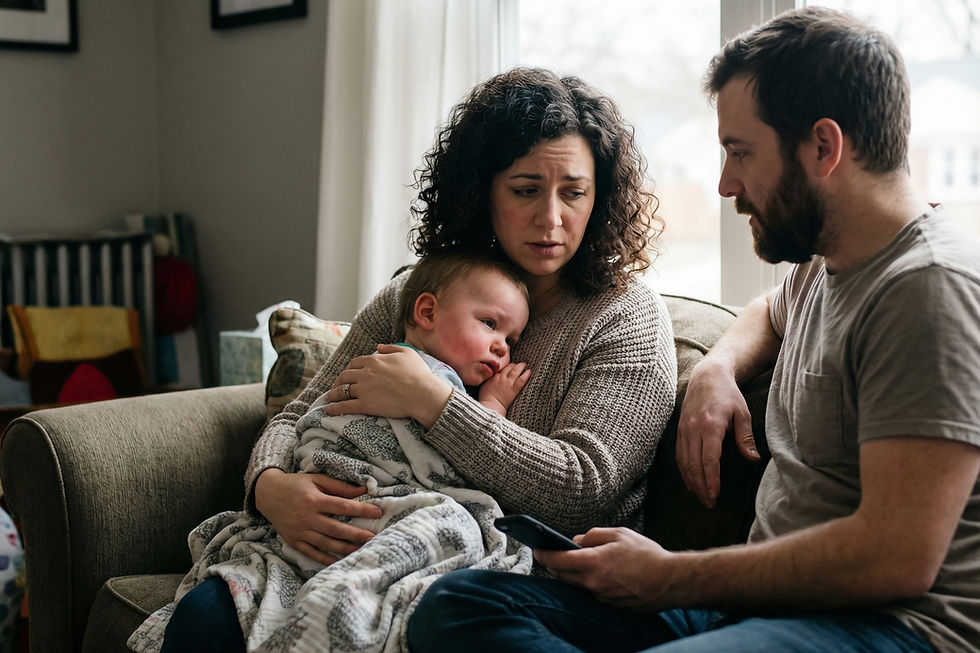
My one-year-old was diagnosed with laryngitis. Is that the same as croup, which I hear involves a barking cough? Does a laryngitis diagnosis automatically mean my baby needs to be hospitalized, or can I monitor them at home if they seem to be doing okay?
Answer:
I understand you must be concerned about your one-year-old's laryngitis diagnosis. Let's clarify the condition and when you should seek further care.
【Laryngitis and Croup Cough】
• Laryngitis primarily involves symptoms like a hoarse voice or a sore throat.
• Croup is a viral infection of the larynx (voice box) and trachea (windpipe). Its key signs are a distinctive "barking" cough, like a seal, and a high-pitched, wheezing sound when inhaling (stridor).
• If a child around one year old has a barking cough, it is highly likely to be croup.
【Deciding on Hospitalization Based on Symptoms】
Most cases of croup can be managed at home; hospitalization is not always necessary.
✅ When you can observe at home:
• Breathing is quiet and normal when the child is calm.
• The child is playing and eating as usual.
• The barking cough only appears occasionally when crying or active.
• There are no retractions (the skin around the chest or neck does not sink in with each breath).
🏥 Signs to revisit the hospital or consider admission:
• Stridor (the high-pitched wheezing sound) is heard continuously, even when the child is calm.
• You see retractions (the skin below the rib cage or collarbones sucks in with each breath).
• The child's lips turn bluish or they appear to be struggling to breathe.
• The child is drooling and has difficulty swallowing.
• The child is extremely irritable or becomes limp and lethargic.
【What to Do at Home Now】
• Expose your child to cool night air or steam from a humidifier for about 15 minutes.
• Hold your child in an upright position to ease breathing.
• Offer small, frequent sips of fluids to stay hydrated.
• Try to keep your child as calm as possible, as crying can worsen symptoms.
【What to Ask Your Doctor】
• "What are the specific signs that my child's symptoms are getting worse?"
• "Is a steroid prescription necessary for my child?"
• "What should I do if the symptoms become more severe during the night?"
If you notice even one of the warning signs listed above, have your child re-evaluated by a doctor the same day. Most children start to feel better within 2-3 days, so please monitor them closely.

For extra peace of mind and clear guidance when tracking your child's symptoms, the FeverCoach app is always there to help.