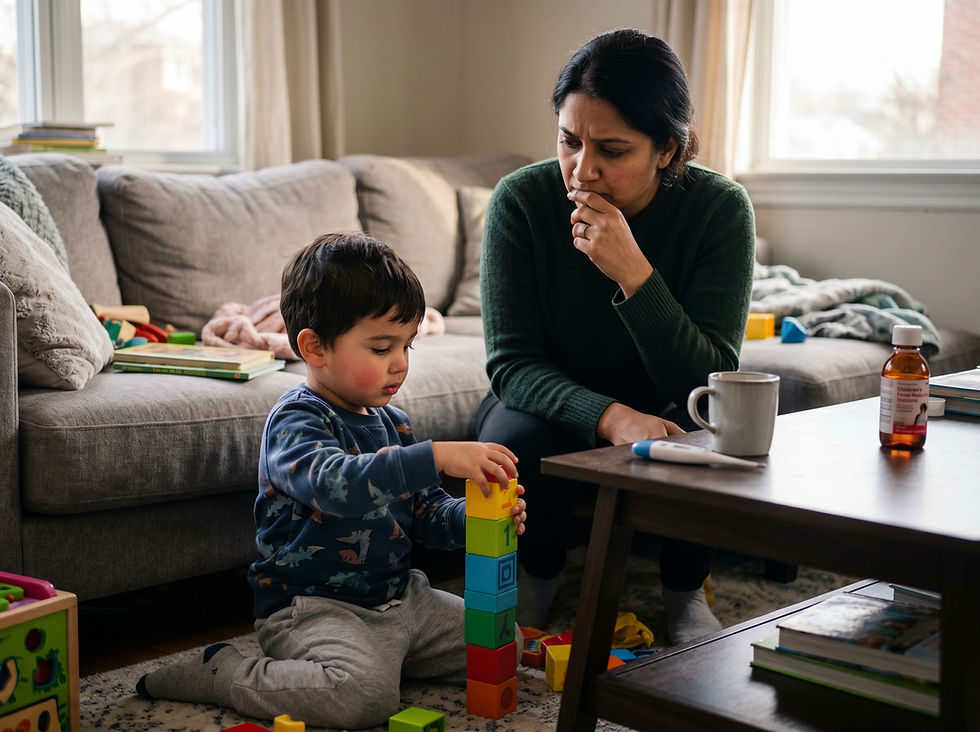
Q: Can sinusitis cause a mild fever in my child? The high fever dropped after antibiotics, but a mild fever of 37.5-37.7°C comes and goes.

Updated: Sep 7
Medically reviewed by Sang Hyun Ahn, MD
Content edited by Myeongchan Kim, MD
This post is a dramatization of a question and answer session experienced by our actual medical reviewers. Please note that this content is for informational purposes only and does not constitute medical advice. Always consult with a qualified healthcare professional for any health concerns or before making any decisions related to your health or treatment.

Question:
My child has had a cold, and recently their runny nose and phlegm cough got much worse. The doctor diagnosed them with sinusitis but kept them on the same antibiotics since the bacteria is the same. A couple of days ago, my child had a fever in the low 38°C range and took fever reducers. That evening, we started the antibiotics. The next morning, the fever went up to 38.1°C but then dropped on its own without reducers.
Since then, their temperature has mostly been normal (low 37°C range), but occasionally we see an ambiguous mild fever of 37.5 to 37.7°C. When sleeping, my child's hands and feet get warm, their forehead gets sweaty, and then the temperature drops down to the mid-36°C range. Today, the mild fever is lingering again. Can a severe runny nose or sinusitis cause this? Should I be worried about this mild fever lasting a few days, even though it drops to normal at night?
Answer:
It is completely understandable to be worried in this situation. However, based on the symptoms you described, there are several reassuring signs.
Current Status Evaluation & Reassuring Signs
The most positive sign is that the high fever (over 38°C) dropped without the need for fever reducers after you started the antibiotics. Additionally, the fact that your child's temperature returns to normal at night, and that their body regulates temperature well while sleeping (hands getting warm, sweating, then dropping to the 36°C range), indicates that their body is recovering properly.
Reasons for the Mild Fever (37.5~37.7°C)
Recovery Process: Even if the antibiotics are working well, it can take 2 to 3 days for the inflammation from the sinusitis to fully subside.
Respiratory Effort: A severely stuffy nose and the physical effort of coughing can naturally raise body temperature slightly.
Daily Activities: A temperature of 37.5 to 37.7°C is near the upper limit of normal. It is entirely normal for a child's temperature to temporarily rise to this range after eating, crying, or playing.
Home Care Guidelines
Antibiotics: Make sure to finish the entire course of antibiotics exactly as prescribed by your doctor (usually 5 to 7 days). Do not stop early just because the fever dropped.
Nasal Care: Use saline drops and a nasal aspirator to safely clear the mucus 4 to 6 times a day.
Hydration: Offer fluids frequently in small amounts to prevent dehydration.
Environment: Dress your child lightly and keep the room temperature comfortable (around 20-22°C).
Fever Reducers: You do not need to give fever reducers for a mild fever of 37.5-37.7°C unless your child is very uncomfortable or the temperature exceeds 38°C.
When to Suspect the Flu or Seek Immediate Medical Care
You should bring your child back to the clinic for a re-evaluation (and possible flu testing) if any of the following occur:
A fever of 38°C or higher returns, or if the fever lasts for more than 3 days.
The fever does not drop even after giving fever reducers.
Your child becomes extremely lethargic, refuses to eat, or has not urinated for 8 hours or more.
They show signs of severe ear pain or fluid draining from the ear.
They have difficulty breathing (such as flaring nostrils or the skin under the ribs pulling in).
In summary, because the initial high fever dropped after starting antibiotics, this current mild fever is highly likely just a normal part of the recovery process. Continue the prescribed medications and nasal care at home, and consult your pediatrician for an in-person evaluation if the high fever returns or if you notice any of the warning signs mentioned above.

For extra peace of mind and clear guidance when tracking your child's symptoms, the FeverCoach app is always there to help.