


Q: My child's fever spiked to 39°C after being diagnosed with a cold. Is it too early for a flu test?

Updated: Sep 7
Medically reviewed by Sang Hyun Ahn, MD
Content edited by Myeongchan Kim, MD
This post is a dramatization of a question and answer session experienced by our actual medical reviewers. Please note that this content is for informational purposes only and does not constitute medical advice. Always consult with a qualified healthcare professional for any health concerns or before making any decisions related to your health or treatment.
Question:

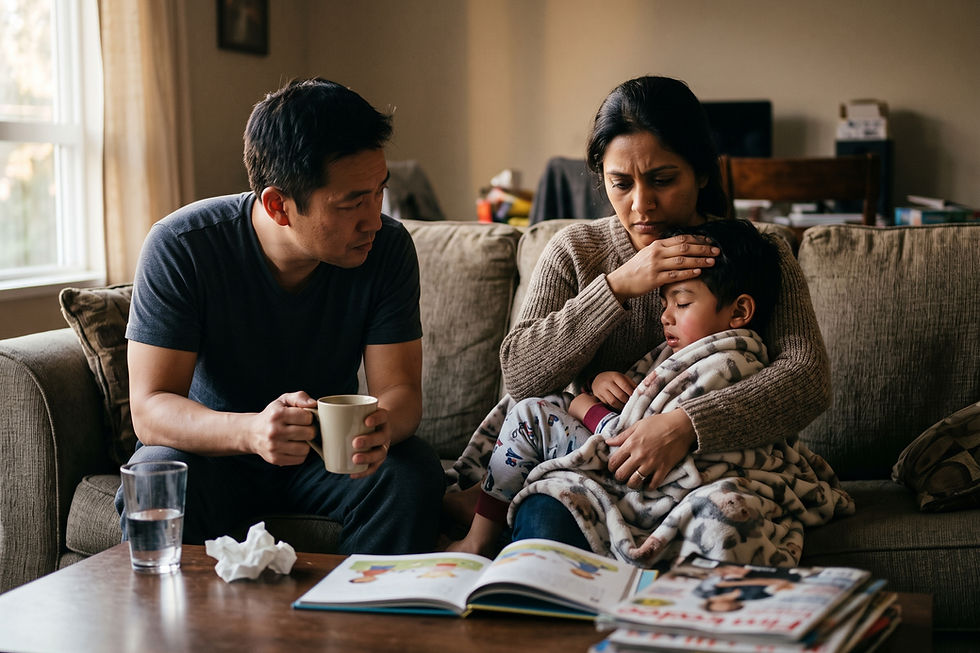
My child started having a low-grade fever on Saturday evening. I gave a fever reducer once and took them to the clinic, where the doctor diagnosed it as a cold. They were completely fine afterward, and even at 1 AM today, their temperature was normal (36.8-36.9°C). However, the fever has suddenly spiked to nearly 39°C now. I am thinking about taking them for a flu test as soon as morning comes. Will the test be able to detect the flu if we do it right away?
Answer:
It is completely understandable that you are worried about your child's fluctuating fever over the weekend. To summarize the situation: the low-grade fever began on Saturday, improved on Sunday, and suddenly spiked to near 39°C early this morning. Given this change in the fever pattern, it is very reasonable to consider the possibility of the flu despite the initial cold diagnosis.
Flu Test Timing:
The accuracy and detection rate of a rapid flu test increase significantly when it is performed at least 12 hours after the onset of symptoms. Since your child's symptoms began on Saturday evening, doing the test this morning will be well within the window to yield accurate results.
What You Can Do at Home Now:
• Fever Reducers: Administer the appropriate medication dose based on your child's age and weight, but only do so if the fever is making them uncomfortable.
• Hydration: Offer small sips of fluids very frequently, about every 5–10 minutes.
• Environment: Dress your child lightly and maintain a comfortable room temperature. Please avoid using wet towels or lukewarm baths to bring the fever down, as this is no longer recommended.
• Urine Output: Monitor their bathroom use. No urine for 8 hours or more is a clear sign of dehydration.
When to Seek Immediate Medical Care:
Please bring your child to an urgent care or emergency room right away if you notice any of the following warning signs:
• Difficulty breathing (e.g., chest retractions where the skin pulls in under the ribs, flaring nostrils, or wheezing).
• Severe lethargy, extreme sleepiness, or an inability to make eye contact.
• No urine output for more than 8 hours.
• The fever persists for more than 3 days or continues to worsen.
Flu Antiviral Treatment:
Antiviral medications for the flu are most effective when started within 48 hours of symptom onset. Considering the symptoms started on Saturday evening, getting tested and receiving a prescription this morning would be ideal for the medication to work best.
Please schedule an appointment with your pediatrician this morning for a proper evaluation and flu test. However, if any of the severe warning signs mentioned above appear before your appointment, take your child to the nearest emergency room or urgent care immediately.
For extra peace of mind and clear guidance when tracking your child's symptoms, the FeverCoach app is always there to help.



![📢 [Important Notice] Still free on Android. Create an account now for lifetime free access.](https://static.wixstatic.com/media/5d15bb_40d773cc6ee24ab5aaf4fcca88617463~mv2.png/v1/fill/w_980,h_653,al_c,q_90,usm_0.66_1.00_0.01,enc_avif,quality_auto/5d15bb_40d773cc6ee24ab5aaf4fcca88617463~mv2.png)