


The Nutrition Behind Febrile Seizures: What the Research Actually Says

If your child has ever had a febrile seizure, you know the feeling: one moment they're feverish and fussy, the next their body stiffens and time stops. It's one of the most frightening things a parent can witness — and one of the most common, affecting 2-5% of children between 6 months and 5 years. And the fear often outlasts the fever: the sleepless nights, a hand on their chest, a jolt of dread every time the thermometer climbs.
The good news is that the vast majority are simple febrile seizures — brief, self-limited, and not linked to lasting harm. But "benign" rarely makes a parent feel less powerless. So here's a question that doesn't get enough attention: what happens in a small child's brain during a fever, and can everyday nutrition play a role?

Why a fever can tip a young brain toward a seizure
A developing brain is a work in progress. In the first few years of life, the balance between the brain's "accelerator" (excitatory signaling, largely driven by glutamate) and its "brake" (inhibitory signaling, driven by GABA) is still maturing. That balance is what keeps ordinary electrical activity from spilling over into a seizure.
A fever adds stress to this system. When a child's temperature climbs during an infection, the body releases inflammatory messengers called cytokines, and core temperature itself changes how neurons fire. In a young brain that is already more excitable than an adult's, this can briefly lower the seizure threshold — the point at which normal activity tips into a seizure. This is why febrile seizures cluster in toddlerhood and then largely disappear as the brain matures.
Several micronutrients are part of the machinery that maintains that excitatory–inhibitory balance. That's the thread researchers have been pulling on for years, and it's where the nutrition conversation begins.

What the research shows about specific nutrients
No vitamin or mineral prevents or treats febrile seizures. But across case-control studies, children who've had one tend to run lower on several key nutrients. Here's the quick comparison — with the detail on each just below.
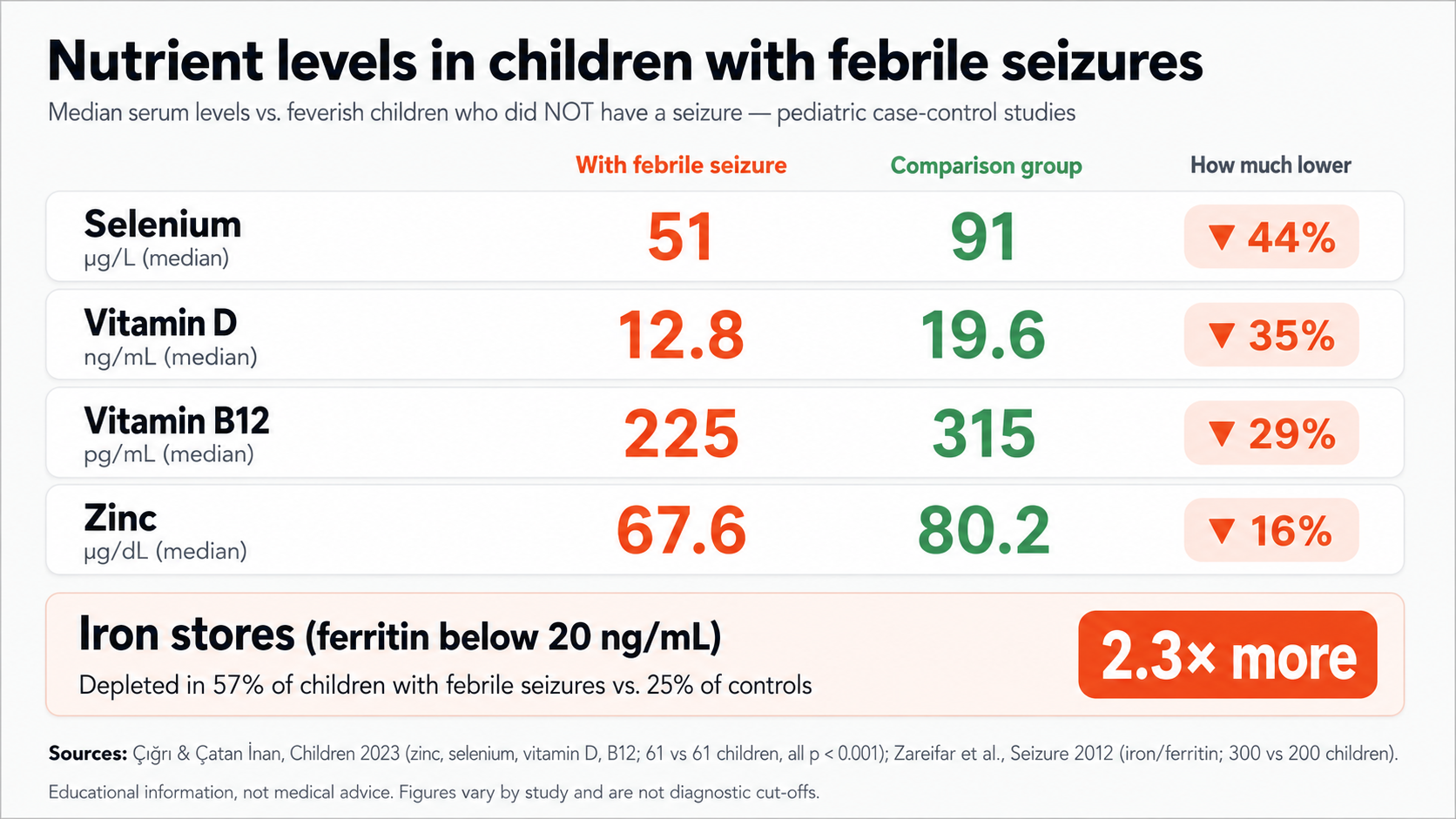
See the numbers as a table
Nutrient | Febrile-seizure group | Comparison group | Source |
Iron (ferritin < 20 ng/mL) | 56.6% deficient | 24.8% deficient | Zareifar et al., 2012 |
Selenium | 51 µg/L (median) | 91 µg/L | Çığrı & Çatan İnan, 2023 |
Vitamin D | 12.8 ng/mL (median) | 19.6 ng/mL | Çığrı & Çatan İnan, 2023 |
Vitamin B12 | 225 pg/mL (median) | 315 pg/mL | Çığrı & Çatan İnan, 2023 |
Zinc | 67.6 µg/dL (median) | 80.2 µg/dL | Çığrı & Çatan İnan, 2023 |
Magnesium | 0.93 mmol/L | 0.97 mmol/L | Wuhan cohort, 2021 |
Comparison groups are feverish children without a seizure. Values are group medians (Çığrı & Çatan İnan, 61 vs 61 children, all p < 0.001) or means (magnesium — where 26% of febrile-seizure children had low magnesium vs 9% of controls). Figures vary by study and aren't diagnostic cut-offs.

The detail behind each nutrient
Iron is the most consistent signal. Iron does more than carry oxygen; it's involved in the enzymes that make neurotransmitters and in the myelination of a growing brain. Multiple case-control studies and a large meta-analysis (covering thousands of children) have found that iron deficiency is associated with a higher likelihood of febrile seizures. Notably, ferritin — a marker of the body's iron stores — tends to be a more sensitive indicator than hemoglobin alone. In one prospective study, low ferritin was linked to roughly a sixfold higher odds of a febrile seizure. Iron deficiency is common in toddlers and easy to miss, which makes this one of the more actionable findings.
Zinc appears low in affected children, but supplement trials are mixed. Zinc helps build GABA (the brain's main "brake") and modulates the receptors that govern neuronal excitability. Children who experience febrile seizures do tend to show lower zinc levels than feverish children who don't. Where the evidence gets murkier is supplementation: one randomized trial found fewer recurrences in a zinc group (22 percent) versus placebo (38 percent), but a systematic review of the available trials concluded that the overall quality of evidence is low and doesn't yet justify recommending zinc as a preventive. So: a real and interesting association, but not a settled answer.
Magnesium has a plausible mechanism and an observed association. Magnesium sits inside the NMDA receptor channel and helps block the calcium influx that drives over-excitation. Case-control studies have repeatedly found hypomagnesemia to be more common in children with febrile seizures than in controls. Researchers are careful to note that this shows association, not proven cause — but the mechanism is well understood and biologically sensible.
Vitamin D, selenium, vitamin B12, and vitamin B6 play supporting roles. In one single-center case-control study, children with febrile seizures had significantly lower selenium, vitamin D, zinc, and B12 than feverish children without seizures. Vitamin D supports immune regulation and neuroprotection; selenium is an antioxidant that protects nerve-cell membranes; vitamin B12 supports healthy myelination; and vitamin B6 is a required cofactor for the enzymes that produce GABA. The evidence here is thinner than for iron, but each points to the same theme: adequate micronutrient status supports the systems that keep a young brain's electrical activity balanced.
The gap parents feel — and where nutrition fits
Here's the part that surprises many families. For simple febrile seizures, the American Academy of Pediatrics recommends against routine preventive anticonvulsant medication, because the side effects of those drugs outweigh the risks of these brief, benign events. And fever-reducing medicine, while useful for comfort, has not been shown to prevent recurrence.
That leaves a lot of parents in an uncomfortable place: told their child's seizures are "nothing to worry about," yet handed almost nothing to actually do. It's no wonder the experience feels so helpless.

This is exactly where a nutrition-first mindset is worth considering — not as a treatment, and not as a promise, but as one of the few things genuinely within a parent's control. Making sure a growing child has adequate iron, zinc, magnesium, vitamin D, and the other nutrients their developing nervous system relies on is simply good pediatric care. Think of it as building everyday neural resilience: keeping the foundational nutrient status strong so the brain is as well-supported as it can be, fevers or not.

Practical, sensible takeaways
Ask about iron. Because ferritin can be low even when hemoglobin looks normal, it's reasonable to talk to your pediatrician about your child's iron status, especially if your toddler is a picky eater or drinks a lot of cow's milk.
Focus on food first. A varied diet — lean meats, beans, whole grains, dairy or fortified alternatives, and plenty of fruits and vegetables — covers most of these nutrients naturally.
Consider a well-formulated supplement to fill gaps, particularly for toddlers whose diets are inconsistent. Choose products dosed to pediatric guidelines, and keep any iron-containing product safely out of reach.
Keep perspective. Most febrile seizures are harmless and outgrown. Nutrition is about long-term support, not a fix in the moment.
Always loop in your pediatrician before starting a new supplement, and seek immediate care if a seizure lasts more than 5 minutes, involves only one side of the body, or is followed by unusual drowsiness or confusion.
A note on where this leaves us
The science of micronutrients and febrile seizures is still developing. The associations are real and, in the case of iron, fairly consistent; the mechanisms are well understood; but firm, cause-and-effect proof — and clear supplementation guidelines — aren't fully there yet. What is clear is that supporting your child's overall nutritional foundation is a reasonable, low-risk thing to do, and one that gives worried parents something constructive to focus on.
Sources
Çığrı E, Çatan İnan F. Comparison of Serum Selenium, Homocysteine, Zinc, and Vitamin D Levels in Febrile Children with and without Febrile Seizures. Children (Basel), 2023 — zinc, selenium, vitamin D, B12. Link
Zareifar S et al. Association between iron status and fe
brile seizures in children. Seizure, 2012 — iron/ferritin (56.6% vs 24.8% deficient). Link
Serum hypomagnesemia is associated with febrile seizures in young children. 2021 — magnesium (0.93 vs 0.97 mmol/L; low in 26% vs 9%). Link
Zinc Status and Febrile Seizures (case-control, 2020) — zinc deficiency and febrile-seizure risk. Link
Efficacy of zinc sulfate supplement on febrile seizure recurrence prevention in children with normal serum zinc level: a randomised clinical trial. 2015 — recurrence 22% vs 38%. Link
American Academy of Pediatrics. Febrile Seizures: Clinical Practice Guideline for the Long-term Management of the Child With Simple Febrile Seizures. Pediatrics, 2008 — prevalence and management. Link
This article is for general educational purposes and is not medical advice. It is not intended to diagnose, treat, cure, or prevent any condition. Please talk with your child's pediatrician about any questions regarding your child's health, nutrition, or supplements.
Related Product

