
Q: My child was discharged after a week of unexplained fever, but the fever returned. Could it be the flu since I recently tested positive?
- Myeongchan Kim, MD

- Jun 6
- 3 min read
Updated: Jul 8
Medically reviewed by Sang Hyun Ahn, MD
Content edited by Myeongchan Kim, MD
This post is a dramatization of a question and answer session experienced by our actual medical reviewers. Please note that this content is for informational purposes only and does not constitute medical advice. Always consult with a qualified healthcare professional for any health concerns or before making any decisions related to your health or treatment.
Question:
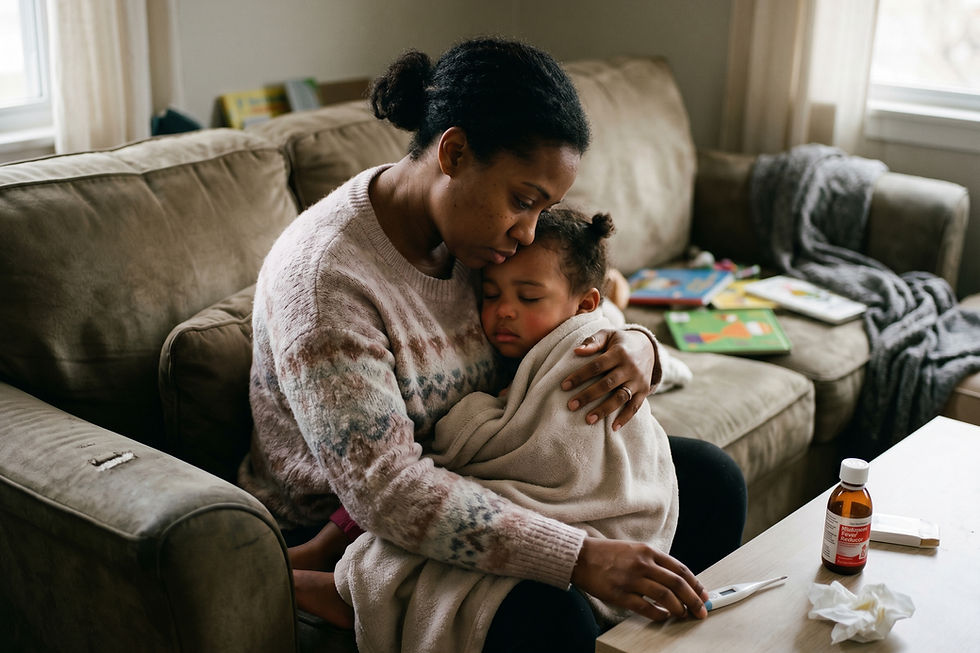
My child had a high fever (38-39°C) late last month and was treated with IV fluids and cold medicine. The fever returned early this month (over 38.3°C). After visiting local pediatricians and an ER, my child was hospitalized for about a week. Extensive tests (flu, COVID-19, X-rays, blood tests, echocardiogram) all came back normal. The child had no other symptoms and was in good condition. The fever finally broke after trying about three different antibiotics, and my child was discharged a few days later.
However, on the day of discharge, the temperature rose to 37.7°C in the evening. The next day it was 36.9°C in the morning but went up to 37.8°C in the evening. Early this morning (4 AM), it spiked to 38.6°C, so I gave a fever reducer. We have an outpatient follow-up appointment scheduled in two days.
Should I take my child to the hospital right away, or wait and observe? Is this a continuation of the previous illness, or a new fever? Also, while caring for my child in the hospital, I felt chills and tested positive for the flu. I was with my child until the day before their fever broke. Since my child had no fever at that time, they weren't tested for the flu again. Could this new fever be the flu?
Answer:
It is completely understandable that you are anxious about your child's fever returning right after being discharged from the hospital.
Based on your timeline, your child's fever resolved for a few days but has now rebounded to 38.6°C. While in the hospital, extensive tests were all negative, and the fever eventually responded to antibiotics. Furthermore, you (the caregiver) recently tested positive for the flu.
What you should do at home right now:
Give fever reducers only when uncomfortable: There is no need to give medication for a mild temperature of 37.5–37.8°C unless your child is in distress.
Provide fluids: Offer small, frequent sips of water to prevent dehydration.
Keep the child comfortable: Dress them in light clothing and maintain an appropriate room temperature. Avoid wiping them down with wet towels or giving tepid baths.
Monitor daily: Keep a close eye on their urine output (not urinating for 8+ hours is a sign of dehydration), overall activity level, appetite, sleep, and breathing (watch for rapid breathing or the skin sucking in under the rib cage).
When to visit the hospital immediately:
If you notice any of the following signs, contact the hospital's ER or outpatient clinic today:
Breathing difficulties: Shortness of breath, flaring nostrils, chest retractions, or bluish lips.
Severe lethargy: The child is very floppy or difficult to wake up.
Signs of dehydration: No urine for 8 hours, or a very dry mouth and tongue.
Persistent high fever: A fever of 38.5°C or higher lasting for more than 24 hours, or a fever that rebounds within 4–6 hours despite medication.
New symptoms appear: Such as a rash, vomiting, abdominal pain, severe headache, or a stiff neck.
Could it be the flu?
Since you tested positive for the flu and were in close contact with your child, there is certainly a possibility. However, your child's initial hospital tests were negative, and their fever had previously resolved. Without a physical examination, it is impossible to determine definitively whether this is a new infection (like the flu) or the tail-end of the previous illness. This requires a comprehensive clinical judgment by a doctor.
What to do until your follow-up appointment:
If none of the danger signs listed above are present, and your child is eating and playing reasonably well, you can continue to observe them at home and attend your scheduled appointment in two days. However, if the fever stays above 38.5°C for over 24 hours or your child's condition rapidly changes, you should visit the hospital immediately.
Questions to ask the doctor at your follow-up:
Is this new fever caused by a new infection (like the flu), or is it a recurrence of the previous illness?
Are additional tests, such as a flu re-test or follow-up blood work, necessary?
Should antibiotics be restarted, or is it safe to just observe?
How many more days should we monitor the fever at home?
Please continue to monitor your child using the checklist provided above, and seek an in-person medical evaluation immediately if any concerning signs develop.

For extra peace of mind and clear guidance when tracking your child's symptoms, the FeverCoach app is always there to help.