
Q: My 8-year-old daughter has had a mild fever for 2 weeks, frequent clotted nosebleeds, and low iron levels. What should we do?

Updated: Sep 7
Medically reviewed by Sang Hyun Ahn, MD
Content edited by Myeongchan Kim, MD
This post is a dramatization of a question and answer session experienced by our actual medical reviewers. Please note that this content is for informational purposes only and does not constitute medical advice. Always consult with a qualified healthcare professional for any health concerns or before making any decisions related to your health or treatment.
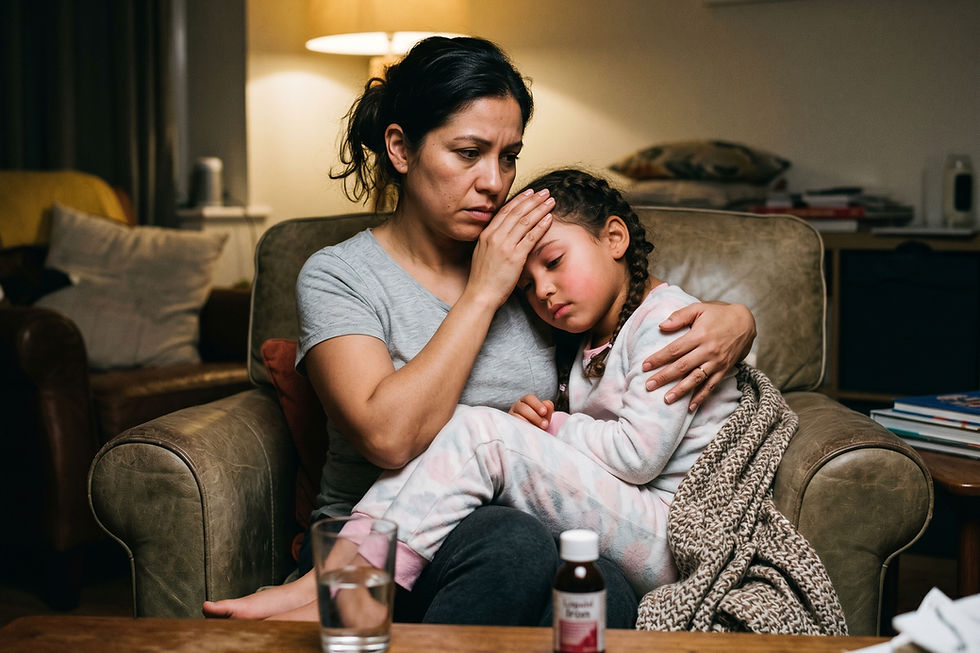
Question:
My 8-year-old daughter has been having a fever around 38°C (100.4°F) for two weeks. We tested her for the flu and COVID-19 twice, and both were negative. She has no other noticeable symptoms. Her normal baseline temperature is naturally a bit high at 37.3°C (99.1°F), but it keeps fluctuating between 37.9°C and 38.3°C several times a day.
After a week of this, we went to the clinic. Her blood and urine tests showed that her inflammation markers were completely fine. She usually gets nosebleeds quite often, but recently she has been passing repeated clotted nosebleeds. We went back today for another blood test, and the doctor said her iron levels are about half of the normal range. They prescribed an iron supplement and noted that all other levels were normal.
However, just a little while ago, she became very lethargic and her temperature spiked to 38.3°C again. I don't know what other tests we should pursue or what steps to take next.
Answer:
It is completely understandable that you are worried about your daughter's persistent mild fever over the past two weeks.
To summarize the situation, your 8-year-old daughter has had fluctuating temperatures between 37.9°C and 38.3°C for two weeks, accompanied by clotted nosebleeds and low iron levels. Fortunately, her inflammation markers are normal, and flu/COVID-19 tests were negative.
Here is what you can do at home right now:
Start the iron supplements: Administer them consistently as prescribed by your doctor. Anemia (low iron) can sometimes contribute to fatigue, worsened nosebleeds, and even mild fevers.
Ensure adequate rest and hydration: Encourage her to drink plenty of fluids, dress her in lightweight clothing, and keep the indoor temperature comfortable.
Keep a symptom diary (for the next 3-5 days):
Record the exact time and temperature readings.
Note the frequency, volume, and color of her nosebleeds.
Observe any changes in her appetite, activity levels, and sleep patterns.
Watch for any new symptoms (e.g., joint pain, rashes, or weight loss).
Questions to discuss with your pediatrician at your next visit:
"When should we repeat the blood test to check her iron levels after starting the supplement?"
"If the mild fever persists, are there any additional tests we should consider (such as rechecking CRP, a peripheral blood smear, autoimmune antibodies, or a urine culture)?"
"What should our ongoing observation plan be, and what specific criteria should prompt us to bring her back in?"
⚠️ Warning signs that require immediate same-day medical evaluation:
Fever spiking to 39°C (102.2°F) or higher, or a fever that does not drop after taking fever-reducing medication.
Nosebleeds that do not stop after 20 minutes of firm, continuous pressure, or if the bleeding volume suddenly increases.
Severe lethargy, difficulty waking her up, or shortness of breath.
The appearance of new symptoms such as a rash, joint swelling, sudden weight loss, or drenching night sweats.
Next Steps:
Please continue giving her the prescribed iron supplements and maintain the symptom diary for 3 to 5 days. After this period, follow up with your pediatrician in person to review the diary, ask the questions listed above, and discuss any further evaluation. Depending on her progress, your doctor may eventually consider a referral to a pediatric hematologist or an ENT (Ear, Nose, and Throat) specialist for more specialized care. You are doing a great job monitoring her—just take it step by step alongside her doctor.

For extra peace of mind and clear guidance when tracking your child's symptoms, the FeverCoach app is always there to help.