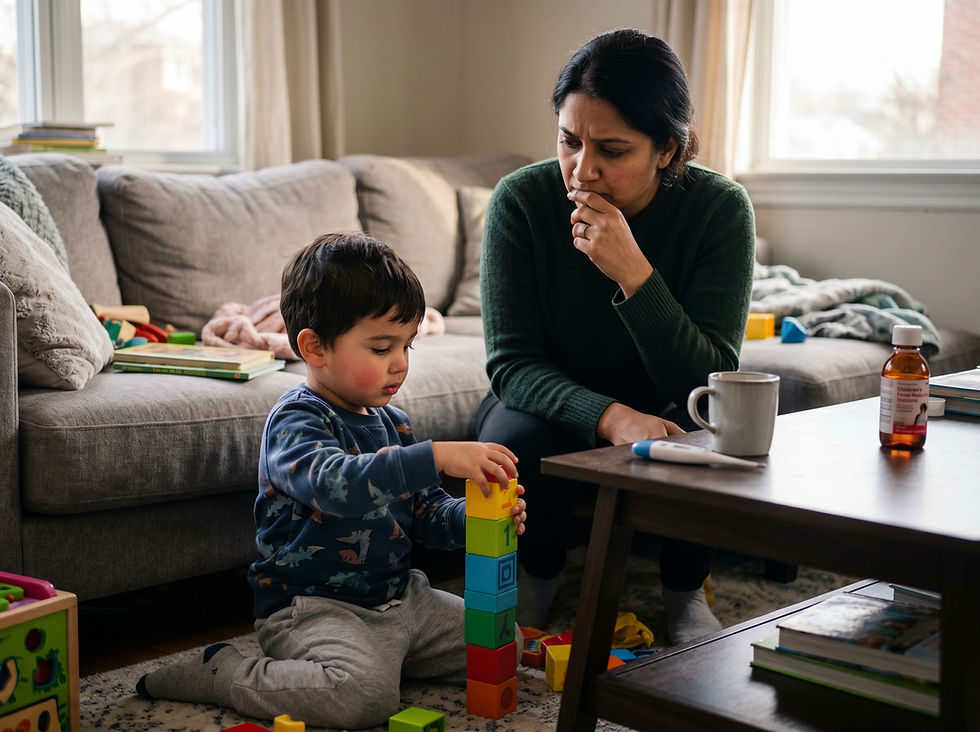
Q: My 30-month-old has had a fever for 4 days with a severe runny nose and eye discharge. Should we re-visit the doctor and test for RSV/Adenovirus?

Updated: Sep 7
Medically reviewed by Sang Hyun Ahn, MD
Content edited by Myeongchan Kim, MD
This post is a dramatization of a question and answer session experienced by our actual medical reviewers. Please note that this content is for informational purposes only and does not constitute medical advice. Always consult with a qualified healthcare professional for any health concerns or before making any decisions related to your health or treatment.

Question:
My 30-month-old daughter has had a fever of around 38.5°C for 4 days. On the first two days, the fever spiked about twice a day, and she had mild diarrhea. From the third day, the fever intervals became shorter, spiking 3 to 4 times a day. The diarrhea has resolved after taking a prescribed probiotic, but she now has a severe runny nose and heavy eye discharge. Despite this, her overall condition and energy levels are fine. We visited the doctor on the second day of the fever, and she is currently taking a prescribed cough and cold syrup.
Is it safe to just observe her at home? Should we go back to the clinic for a re-evaluation? Also, should we get her tested for RSV or Adenovirus?
Answer:
It is completely understandable to be worried when a child's fever lasts for 4 days.
Since her general condition is good and she is breathing comfortably, testing for RSV or Adenovirus may not be strictly necessary right now. Knowing the exact virus often does not change the immediate supportive treatment plan. However, if her respiratory symptoms worsen or the fever persists beyond 5 days, your pediatrician may consider running these tests.
What you can do at home right now:
Hydration: Offer small, frequent amounts of water or electrolyte drinks. Monitor her diapers to ensure she is urinating every 4 to 6 hours.
Comfort: Dress her in light clothing and keep the room temperature comfortable.
Nasal Care: Use saline nasal drops and a nasal aspirator to clear her runny nose. Because the eyes and nose are connected, clearing the nasal congestion will also help reduce the eye discharge.
Fever Management: Give fever reducers only when she appears uncomfortable, strictly following the recommended dosage and time intervals.
When to see the doctor again:
If her symptoms remain stable and her overall condition is good, you can continue to observe her at home today. However, if the fever reaches the 5th day, a re-evaluation by your pediatrician is highly recommended. If possible, contact the same clinic you visited on day 2 so they can review her progress.
Seek immediate medical attention today if you notice any of the following "red flag" signs:
Breathing difficulties: Sucking in of the skin under the ribs (retractions), nasal flaring, or wheezing.
Signs of dehydration: No urine for over 8 hours, or a very dry mouth, lips, and tongue.
Changes in behavior: Extreme lethargy, refusal to play, or poor eye contact.
New severe symptoms: Ear pain, a stiff neck, severe headache, or repeated vomiting.
Worsening fever: The fever continues past 5 days or begins spiking even higher and more frequently.
For today, please focus on keeping her well-hydrated and managing her nasal congestion, and do not hesitate to bring her in for a physical examination if you are concerned about any changes in her condition.

For extra peace of mind and clear guidance when tracking your child's symptoms, the FeverCoach app is always there to help.