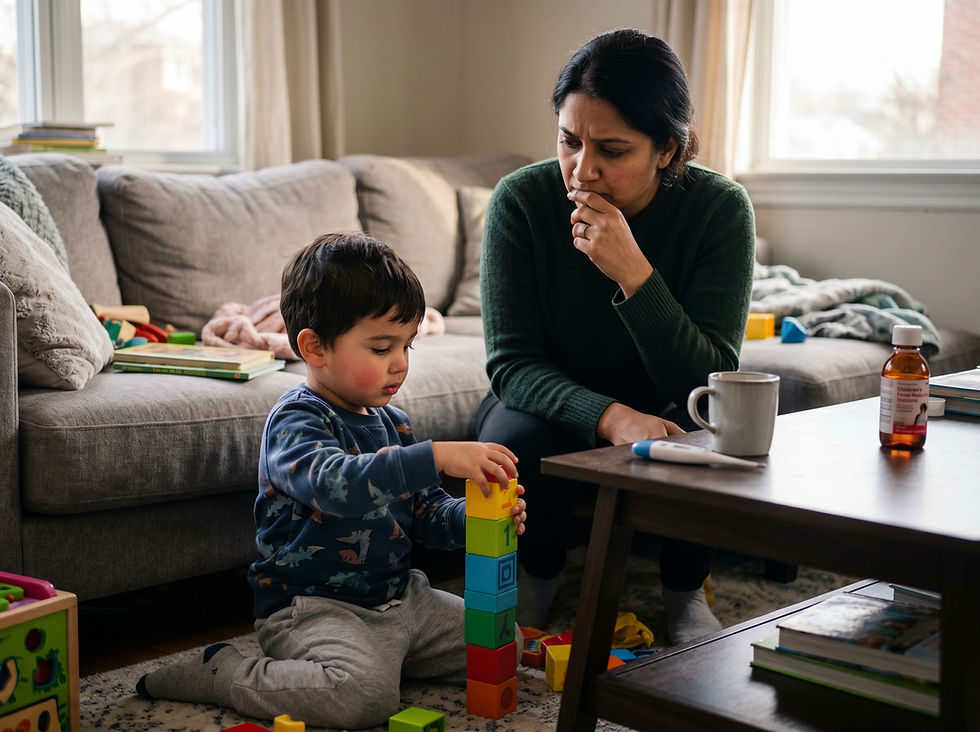
Q: My 22-month-old has had a high fever for 4 days from tonsillitis. The flu test was negative. Should we revisit the doctor?
- Myeongchan Kim, MD

- Jul 9
- 3 min read
Updated: Jul 21
Medically reviewed by Sang Hyun Ahn, MD
Content edited by Myeongchan Kim, MD
This post is a dramatization of a question and answer session experienced by our actual medical reviewers. Please note that this content is for informational purposes only and does not constitute medical advice. Always consult with a qualified healthcare professional for any health concerns or before making any decisions related to your health or treatment.

Question:
My 22-month-old child (12.5 kg) has had a high fever for 4 days. On the first day, they had mildly red eyes, a runny nose, and a cough. We went to the clinic and they were diagnosed with tonsillitis (fever 38.6–39.9°C). On the second day, the fever stayed between 38.5–40.2°C. Even with cross-dosing 5–6 ml of fever reducers every 2 hours, the temperature wouldn't drop below the mid-38s. A flu test came back negative. A chest X-ray showed phlegm in the bronchial tubes but no pneumonia, though the doctor noted severely swollen tonsils with a few bleeding spots. Even after receiving IV fluids, the fever remained in the 39s. Over the third and fourth days, the fever has persisted between 38–40°C. I have been continuously giving fever reducers every 2 hours (5–6 ml).
Can tonsillitis cause such a prolonged high fever? Was the flu test done too early, since they say it takes two days for the flu to show up? Should we visit the doctor again?
Answer:
It must be incredibly exhausting and worrying for you to manage your child's high fever for four straight days. You have been doing a great job monitoring their condition.
Check Your Medication Dosage
You mentioned giving "5–6 ml" of fever reducers. It is critical to check the exact concentration (mg/mL) on the medicine bottle, as dosages vary by brand and type. For a 12.5 kg child:
Acetaminophen syrup (160 mg/5 mL): The appropriate dose is roughly 4–5.5 mL per administration.
Ibuprofen syrup (20 mg/mL): The appropriate dose is roughly 3.5–6 mL.
Dexibuprofen syrup (12 mg/mL): The appropriate dose is roughly 5.5–7 mL.
Depending on the specific medication you are using, the dose might be slightly insufficient. Please bring your medicine bottles to your next clinic visit to confirm the exact dosages with your doctor.
Why You Should Revisit the Doctor Today
Yes, you definitely need to take your child back to the pediatrician or an urgent care center for an in-person evaluation today. Here is why:
Persistent High Fever & Poor Medication Response: Four days of high fever that does not respond well to medication requires reassessment.
Bleeding Spots on Tonsils: Severely swollen tonsils with bleeding spots strongly suggest a potential bacterial infection (such as Strep throat), which may require antibiotics.
Flu Test Timing: Performing a flu test 12 to 48 hours after symptom onset is generally the most accurate window. While the timing of your test on the second day was appropriate, since the high fever is persisting, your doctor may consider a retest or prescribe antiviral medication based on clinical judgment.
Risk of Secondary Infection: With continued phlegm and high fever, your child needs to be evaluated for any secondary bacterial infections, including pneumonia.
Home Care Guidelines
While waiting for your doctor's appointment, continue these supportive measures:
Hydration is Key: Offer frequent, small sips of fluids (water, electrolyte drinks, clear broth, or even a popsicle) every 10–15 minutes.
Monitor Dehydration: Track your child's urine output and color. If there is no urine for more than 8 hours, or if it is a very dark yellow, this is a sign of dehydration.
Environment: Dress the child in light, breathable clothing and keep the room temperature comfortable (around 20–22°C / 68–72°F).
Avoid Physical Cooling: Do not use cold water, tepid sponging, or ice packs, as this can cause shivering and actually raise the core body temperature.
When to Go to the Emergency Room
Seek emergency medical care immediately (call an ambulance or go to the nearest ER) if you notice any of the following danger signs:
Difficulty breathing, breathing very fast, or chest retractions (skin pulling in under the ribs).
Lips or fingernails turning blue.
The child is difficult to wake up, excessively lethargic, or cannot make eye contact.
No urine output for more than 8 hours.
A stiff neck, or severe headache accompanied by repeated vomiting.
While viral tonsillitis can sometimes cause high fevers for 4 to 5 days, your child's specific symptoms warrant a re-evaluation for bacterial infection, a flu retest, and a check for dehydration. Please consult your pediatrician for an in-person evaluation today to ensure your child gets the appropriate treatment.

For extra peace of mind and clear guidance when tracking your child's symptoms, the FeverCoach app is always there to help.