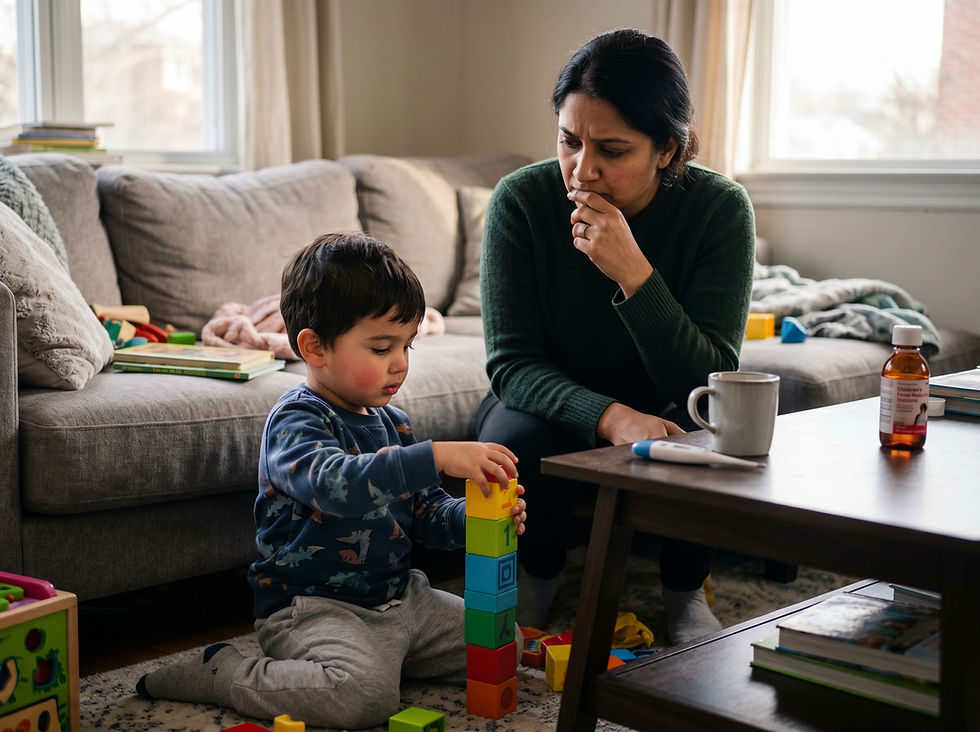
Q: My 17-month-old has a mild fever a week after finishing ear infection antibiotics. Should we see a doctor?

Updated: Sep 7
Medically reviewed by Sang Hyun Ahn, MD
Content edited by Myeongchan Kim, MD
This post is a dramatization of a question and answer session experienced by our actual medical reviewers. Please note that this content is for informational purposes only and does not constitute medical advice. Always consult with a qualified healthcare professional for any health concerns or before making any decisions related to your health or treatment.

Question:
My 17-month-old child has been having a mild fever for a week. We recently finished a course of antibiotics for a cold and a middle ear infection, and currently, there is no cough or runny nose. After finishing the medication, the doctor said my child was fully recovered. However, for the past week, a mild fever has been coming and going. The temperature rises to about 37.8°C (100°F) a couple of times a day and then drops back to a normal 36.6~36.7°C (97.9~98°F).
Should I take my child back to the hospital, or should I wait and observe? If I should wait, how much longer should I observe? My child is not fussy at all and is playing very well.
Answer:
It is completely understandable that you are worried about the lingering mild fever even after finishing the antibiotic treatment.
Based on your description, your 17-month-old has completed treatment for a cold and middle ear infection (otitis media) and has no respiratory symptoms, but is experiencing a mild temperature elevation up to 37.8°C (100°F) twice a day before returning to normal. It is very reassuring that your child is playing well and not acting fussy.
Reassuring Points & Possible Causes:
It can sometimes take 1 to 2 weeks for a child's body temperature regulation to completely stabilize after recovering from a middle ear infection.
A temperature of 37.8°C is a mild elevation. Since your child is active and assuming their hydration and urine output are normal, the likelihood of a severe reinfection is low.
However, if a mild fever persists after finishing antibiotics, it is important to consider possibilities such as a mild recurrence of the ear infection, a new overlapping viral infection, or, rarely, incomplete clearance of the initial bacteria.
What You Can Do at Home:
Keep a temperature log 3 to 4 times a day, noting both the time and the child's activity level when the reading is taken.
Maintain good fluid intake to keep your child hydrated, and dress them in light, breathable clothing.
Monitor for specific signs such as pulling or rubbing at the ears, increased fussiness, or changes in appetite and sleep patterns.
When to Revisit the Pediatrician:
Please take your child in for a medical evaluation if any of the following occur:
The mild fever continues for more than 2 weeks in total.
The temperature rises to 38°C (100.4°F) or higher, or the fever does not drop throughout the day.
Ear pain or fussiness returns, or there is a noticeable decrease in appetite or urine output.
New symptoms develop, such as a skin rash, return of a cough, or vomiting.
If your child continues to play well without any of these warning signs, you can safely observe them at home for another 3 to 4 days. If the mild fever pattern is still present after that observation period, a follow-up visit to your pediatrician is recommended to ensure everything is completely resolved.
For extra peace of mind and clear guidance when tracking your child's symptoms, the FeverCoach app is always there to help.