
Preschool Vision Screening: Ages 3–5 and What to Expect

Every child should have a vision screening at least once between ages 3 and 5, even if they seem to see well. If your child cannot read letters or complete an eye-chart test, ask about a picture or matching test, screening with a special device, or an eye-exam referral. An incomplete test is not a pass. Symptoms or concerns need attention at any age; do not wait for the preschool screening window.
Why screen a child who seems to see well?
Amblyopia, often called “lazy eye,” happens when vision in one or both eyes does not develop properly during childhood. The brain relies more on the eye providing a clearer image, so a child may manage everyday activities without anyone noticing a problem. The eyes may look normal.
Unequal focusing needs between the eyes or eyes that do not line up can contribute to amblyopia. Screening looks for reduced vision or factors that could interfere with vision development. It does not establish a diagnosis.
When should screening happen?
Eye checks begin during routine care in infancy. Preschool screening adds an age-appropriate check of how well a child sees.
The American Academy of Pediatrics recommends visual-acuity screening at ages 4 and 5 and for cooperative 3-year-olds. Younger children may be screened with special instruments. These recommendations fit with the goal of at least one screening between ages 3 and 5.
At your child's next well-child visit, ask:
Has vision screening been completed, and what was the result?
Was each eye checked separately, or was a screening device used?
Is another screening or a full eye examination needed?
Tell the clinician about a family history of amblyopia or childhood eye problems and anything unusual you have noticed.
What happens during the test?
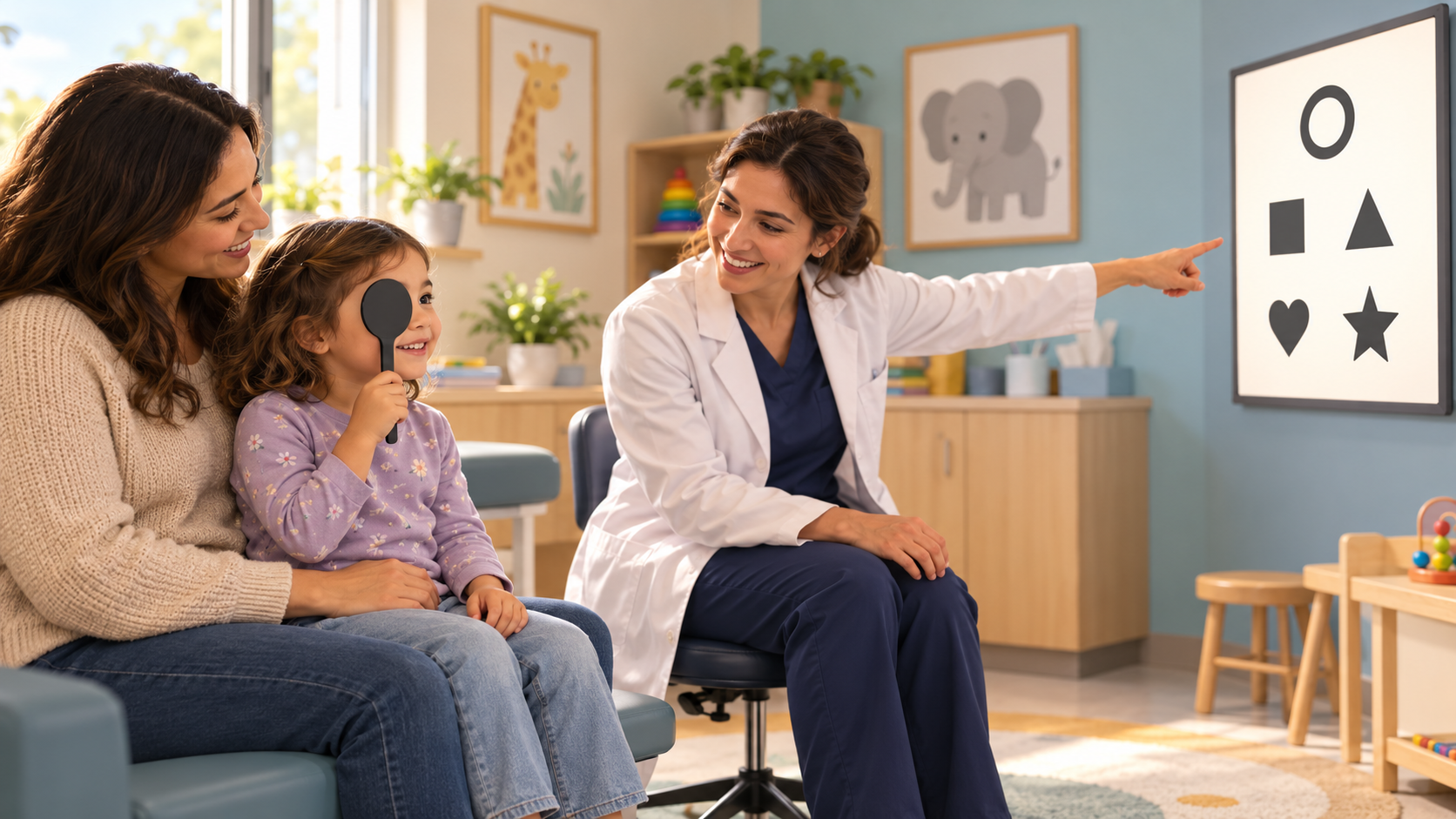
For a chart-based test, a child identifies letters, pictures, or symbols at a set distance, usually with one eye covered at a time. A child who cannot name letters may be able to match symbols to a card. Reading ability is not required for every vision test.
Instrument-based screening uses a device, such as a photoscreener, to look for certain amblyopia risk factors. It can help when a child cannot reliably answer chart questions. It does not replace a full eye examination when one is needed.
Before the visit, explain that your child will play a looking or matching game. Bring their usual glasses and previous screening results, if available. During testing, follow the staff's directions and let your child answer without coaching.
What if my child cannot finish—or does not pass?
Being tired, shy, distracted, or unfamiliar with the task can make screening difficult. An unfinished test does not prove poor vision, but it also does not confirm normal vision.
Leave with a follow-up plan: ask whether your child needs a repeat screening soon, a different screening method, or a comprehensive eye examination. Ask when it should happen and who will arrange it. Do not let an incomplete result simply wait until next year's visit without discussing it.
A result that needs referral also does not automatically mean amblyopia. An eye-care professional experienced with children can check vision, eye alignment, and focusing needs, often using drops to examine the eyes more fully.
If amblyopia is diagnosed, treatment may include glasses and, when prescribed, patching or eye drops. Treatment depends on the cause. Do not start patching or medicated eye drops on your own.
When should I call sooner?
Arrange an appointment if your child repeatedly squints, closes one eye, tilts their head to see, or has an eye that turns inward or outward. A previous passing screening does not rule out a new problem.
Contact your child's clinician promptly, preferably the same day, if you notice a white-looking pupil or a repeated white reflection in the same eye in photos.
Seek emergency care immediately for sudden loss of vision, severe eye pain, or a serious eye injury.
Call 911 if a sudden vision change comes with new weakness, trouble speaking, or loss of consciousness.
For routine screening, the most useful next step is to confirm the result and complete any recommended follow-up. Early detection helps preserve the opportunity to treat vision while it is developing.
This article provides general educational information and does not replace your child's medical or eye care.
By Sang Hyun Ahn, MD