


Holiday Toy Safety: Age Labels, Small Parts, and Button Batteries

Choose holiday toys that match your child’s age and current abilities, and check what younger children in the home could reach. Keep small parts and small balls away from children under 3, and choose battery-powered toys only when their battery compartments close securely. If a child may have swallowed a button or coin battery, go to an emergency department immediately—even if the child seems well.
Start with the age label
Read the recommended age and safety warnings before buying or opening a toy. Age guidance reflects safety considerations as well as the skills needed to use it. Being advanced for their age does not make small parts safe for a younger child.
The US Consumer Product Safety Commission’s toy guidance recommends following package age guidance and keeping small parts and small balls away from children under 3.
Before choosing a gift, ask:
Is it labeled for this child’s age?
Does the child still put objects in their mouth?
Can pieces detach, break off, or become accessible during play?
Could a younger sibling reach the toy or its pieces?
If an older child still mouths objects or has developmental needs that affect safe play, ask their pediatrician for help choosing suitable toys. Supervision does not make an unsuitable toy safe.
Watch small parts and balloons
Look for removable accessories, tiny building pieces, small balls, and parts that could loosen. Recheck toys after use and remove damaged ones from play until they can be safely repaired or replaced.
Keep older children’s small-part toys in a separate play area and store them where younger children cannot reach them. Check the floor after play, including under furniture.
Keep uninflated balloons and broken balloon pieces away from children under 8. Supervise balloon play and discard broken pieces immediately. A balloon used as gift decoration needs the same care as one included in a toy.
Check every battery compartment
Button and coin batteries can cause severe internal burns if swallowed. A child may initially have no obvious symptoms.
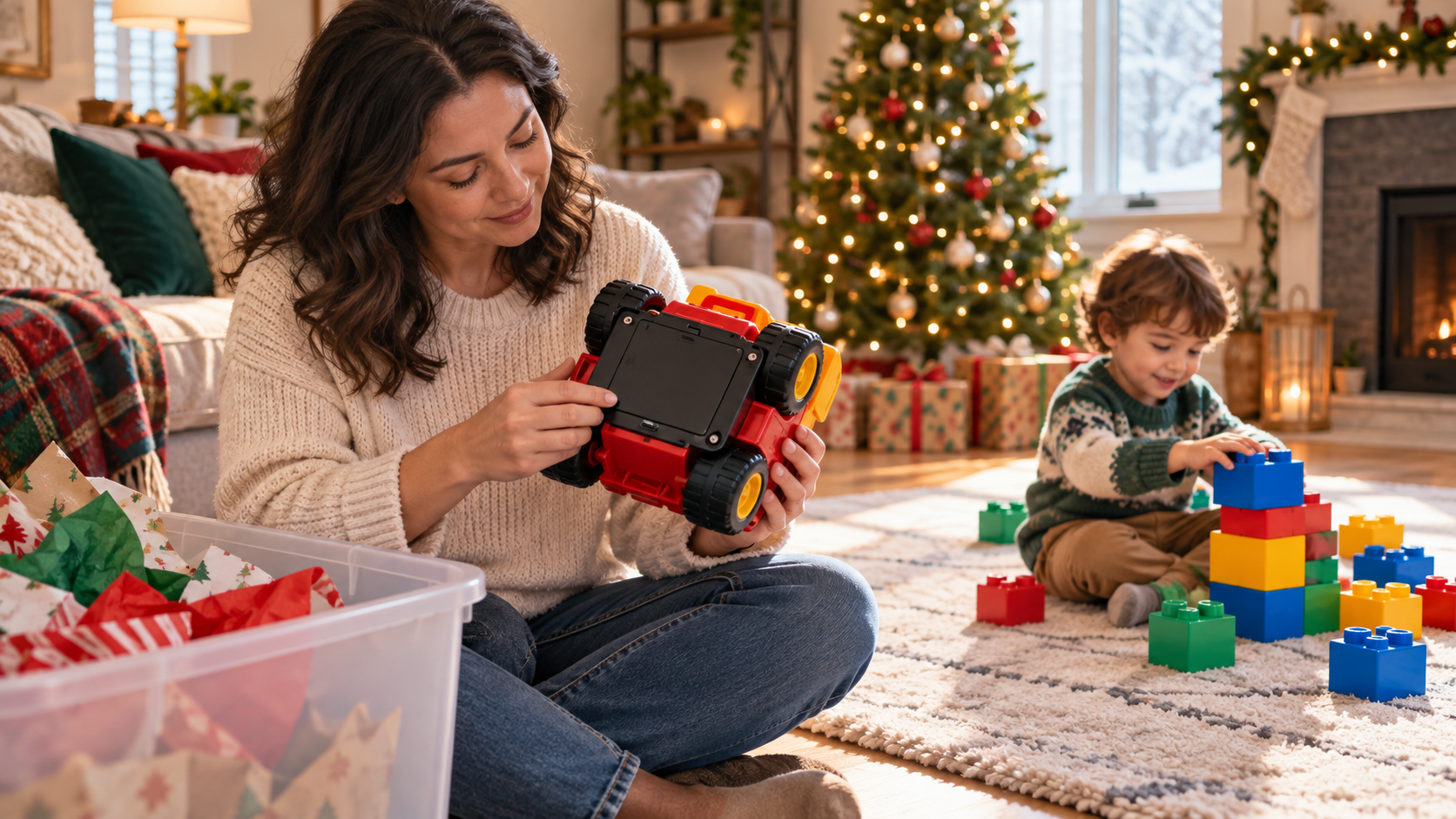
Before giving a toy to a child, check that the battery cover is intact, closes fully, and stays securely fastened. For products using button or coin batteries, check for a screw closure. Keep products with accessible batteries away from children, including products whose covers are missing, loose, or damaged.
The CPSC’s button and coin battery guidance explains the importance of secure compartments. Check nearby remotes, light-up decorations, and electronic gifts too. Keep spare and used batteries out of children’s sight and reach; a used battery can still be dangerous.
Unpack and put away before play
Have an adult open gifts and inspect each toy before handing it over.
Remove plastic wrapping, bags, ties, and other packaging promptly.
Check for loose pieces, damage, and an unsecured battery cover.
Separate older children’s toys from younger children’s play spaces.
Put batteries and small accessories away immediately, including during battery changes.
If gifts include candy, apply a separate food safety check. Our Halloween candy safety guide covers choking and allergy precautions that also matter for holiday treats.
Know when to get help
Choking: If a child cannot breathe, cry, speak, or cough effectively, call 911 immediately and follow the dispatcher’s instructions for age-appropriate choking first aid. Do not use abdominal thrusts on an infant under 1 year. If the child becomes unresponsive, begin CPR as directed. Do not put your fingers blindly into the mouth. If the child can cough effectively, encourage coughing and watch closely; call 911 if breathing worsens.
Possible swallowed battery: Go to an emergency department immediately, even without symptoms or certainty that a battery was swallowed. Call US Poison Control at 1-800-222-1222 while arranging care; do not delay departure to make the call. Do not induce vomiting or give food or drinks unless Poison Control or an emergency clinician instructs you to. Call 911 for breathing difficulty, collapse, or unresponsiveness.
Another swallowed toy part: If breathing is normal, contact the child’s pediatrician promptly for guidance. Persistent coughing, drooling, pain, or trouble swallowing needs urgent medical evaluation. Breathing difficulty requires 911.
This article provides general education and does not replace individual medical advice or emergency care.
By Sang Hyun Ahn, MD
