
Halloween Trick-or-Treating Safety After Dark

To help your child stay safe while trick-or-treating after dark, combine visible, well-fitting costumes with adult supervision and a street-crossing plan. Young children should go with an adult. Older children who are ready to go without an adult should travel in a group with an agreed route and return time. A flashlight or reflective costume helps with visibility, but it cannot guarantee that a driver sees your child.
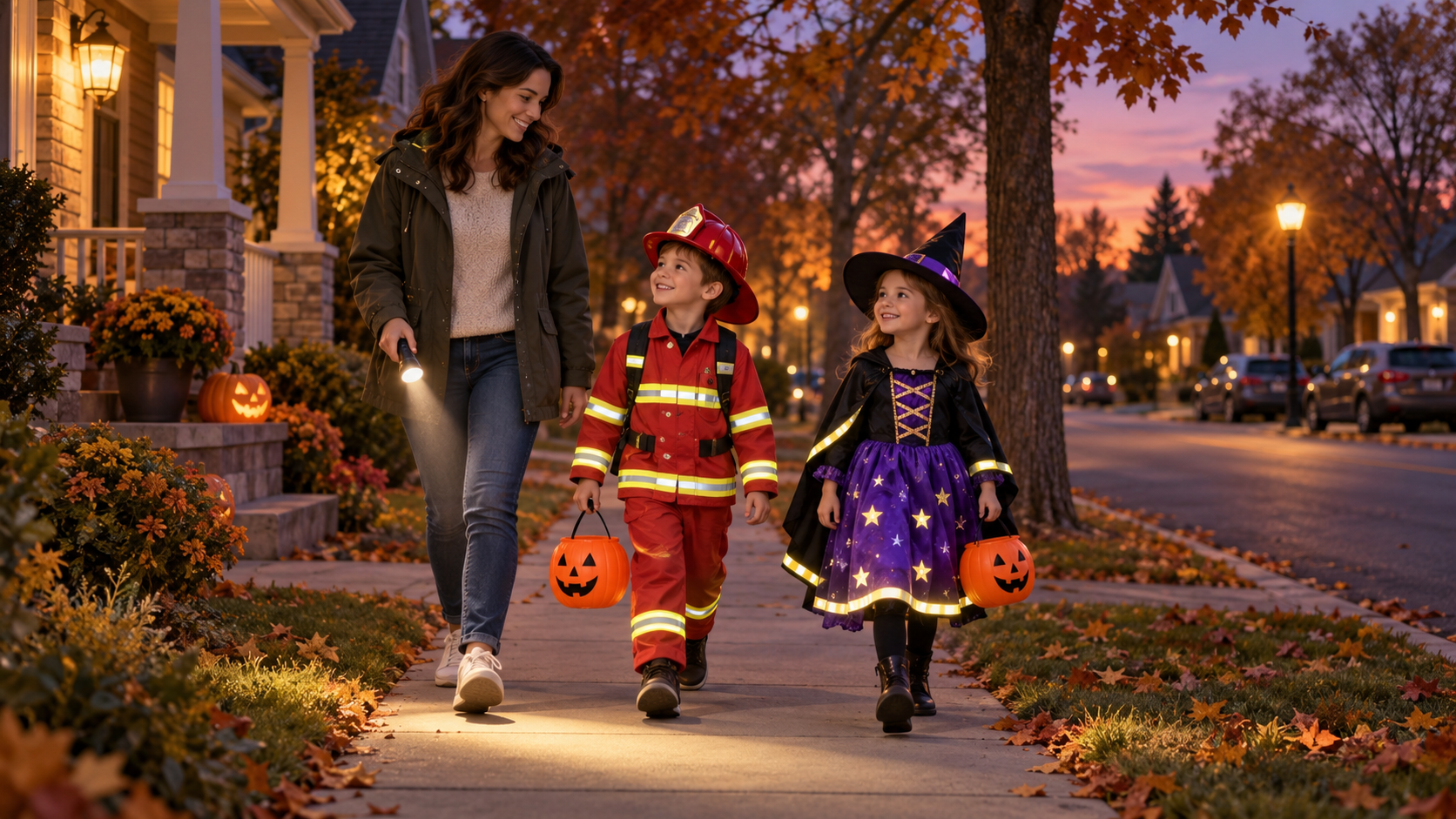
Plan the walk before leaving
Choose a familiar route with sidewalks and places to cross at crosswalks or intersections. If a street lacks a sidewalk or a usable crossing, choose a different route where possible. A shorter outing can make it easier to keep the group together.
Before leaving, agree on these rules:
Stay together and stop at every curb.
Cross streets together at planned crossings.
Never run into the road to reach a house or catch up with friends.
Wait for the adult before changing direction or crossing.
Explain that a tempting porch across the street does not change the crossing plan. Bring a charged phone, but put it away while walking or supervising a crossing.
Check costume fit and visibility
Try the complete costume on before Halloween, including shoes and accessories. Have your child walk, turn, and climb a step so you can spot anything that drags, catches, or makes movement difficult.
Keep hems off the ground and choose shoes your child can walk in comfortably. Avoid masks, hoods, or accessories that block vision. Your child needs to see to both sides without moving or lifting part of the costume.
The American Academy of Pediatrics recommends bright or reflective costumes and flashlights. Add reflective material where it can be seen from different directions, and carry a working flashlight. Check that coats or bags do not cover the reflective parts. Costume lighting and streetlights do not replace supervision or careful crossing.
Match supervision to your child
An adult should accompany young children. Stay close enough to guide them at driveways and crossings, and hold hands when needed. In a group, decide which adult is watching which children so supervision does not become everyone's assumed responsibility.
For older children, age alone does not establish readiness. Consider whether they consistently stop at curbs, follow crossing rules, and stay with friends when excited or distracted.
If they go without an adult, arrange a group, a familiar route, a return time, and a way to contact you. Tell them what to do if they become separated: stop in a safe place away from traffic and call the agreed adult. If they cannot follow the plan reliably, accompany them.
Cross deliberately, even on quiet streets
Use crosswalks or intersections when possible. Stop at the curb and look left, right, and left again. Keep looking for traffic as you cross. At a signal, wait for the pedestrian indication and check for turning vehicles before stepping out.
Wait until vehicles have stopped and the crossing is clear. Do not assume a driver sees you because your costume is bright or another car has stopped. Watch for vehicles approaching from other lanes or directions.
Walk across together. Avoid crossing between parked cars, which can hide children from drivers. Watch for vehicles entering or backing out of driveways, too. Put phones away at crossings and keep attention on the road.
If you are driving that evening
NHTSA advises drivers to slow down and watch for children who may unexpectedly enter the road. Give yourself more time, keep your attention on driving, and check carefully before turning or backing up. Expect children near parked cars, driveways, and intersections.
When an injury needs urgent help
Call 911 if a child is unresponsive, has trouble breathing, has heavy bleeding that will not stop, or has concerning symptoms after a head injury, such as confusion, repeated vomiting, or loss of consciousness.
After a child is struck by a moving vehicle, seek prompt medical assessment even if they initially seem able to walk. Call 911 if a serious injury is possible or you cannot safely transport them. Avoid moving a child with a possible neck or back injury unless there is immediate danger, and follow the dispatcher's instructions.
Sources
This article provides general education for US families and does not replace individualized medical advice.
By Sang Hyun Ahn, MD